Monofocal vs Enhanced Monofocal vs Trifocal IOLs: A Clinical Guide for Cataract Surgeons

Understanding the IOL landscape
IOL selection involves balancing spectacle independence, optical quality, visual range and the possibility of glare or halos. There is no single best lens for every patient.
Monofocal IOLs
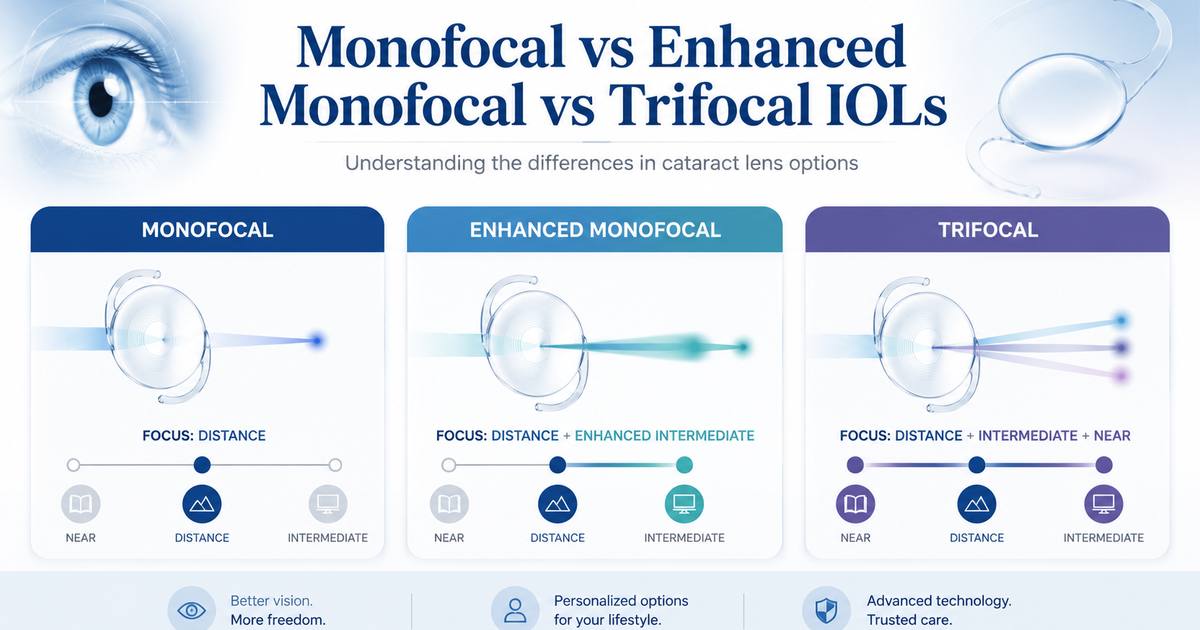
Monofocal lenses provide one main focal point, usually distance. They offer predictable outcomes, excellent contrast and the lowest risk of halos or glare, but reading glasses are commonly required.
Best suited to
- Patients prioritising clarity and contrast
- Frequent night drivers
- Patients with ocular comorbidities
- Patients preferring a simpler, predictable option
Enhanced monofocal and EDOF IOLs
These lenses extend useful vision beyond a standard monofocal, especially at intermediate distance, while generally preserving strong distance vision and a relatively low risk of photic phenomena.
Best suited to
- Patients wanting better computer and dashboard vision
- Patients with low tolerance for halos and glare
- Patients seeking some spectacle reduction without full multifocal optics
Trifocal IOLs
Trifocal lenses provide focal points for distance, intermediate and near vision. They offer the greatest potential for spectacle independence but may cause halos, glare or reduced contrast, especially in low light.
Best suited to
- Highly motivated patients seeking glasses-free vision
- Patients with healthy corneas and maculas
- Patients with realistic expectations and willingness to adapt
Clinical decision framework
- Corneal regularity and previous refractive surgery
- Macular health and OCT findings
- Ocular surface and tear-film stability
- Occupation, lifestyle and night-driving needs
- Tolerance for halos and glare
- Biometry accuracy and availability of enhancement options
Summary comparison
| Feature | Monofocal | Enhanced / EDOF | Trifocal |
|---|---|---|---|
| Distance | Excellent | Excellent | Excellent |
| Intermediate | Limited | Good | Good |
| Near | Glasses usually needed | Glasses often needed | Good to excellent |
| Contrast | Highest | High | Moderate |
| Halos/glare risk | Lowest | Low | Moderate |
| Spectacle independence | Low | Moderate | High |
Conclusion
Monofocal lenses remain the most optically straightforward choice. Enhanced monofocal and EDOF lenses offer useful intermediate vision with limited compromise. Trifocal lenses offer the highest potential for spectacle independence in carefully selected patients. The key is matching the lens to the patient.